SAP is the world-leading ERP software offering for all sizes of enterprise the right business solution. It is your digital back tier core. On the other side, Salesforce is your digital front tier core for your customer success. Business processes starting from your front tier — e.g. Salesforce — and ending at your back tier — e.g. SAP — create a unique business value chain which is essential for your company success. They can only work if the functional interaction and data synchronization smoothly work together. Deep and native integration is therefore the key success factor. But are you aware of how the solution suite can integrate with Salesforce?
Before going into the various integration options between SAP and Salesforce, let's have a look at the business solution landscape of SAP as of today.
SAP Business Solution Suite
Starting from R/2 in the earlier sixties, SAP launched the R/3 suite in the eighties, which follows the Client/Server paradigm. In this range we have SAP R/3 with versions 3.1, 4.0, and 4.7 — the so-called R/3 Enterprise. Later came ECC 6.0 or SAP ERP 6.0. These are the on-premise versions of the SAP ERP Business Suite. For small-size business, SAP launched SAP Business One, which now exists in both on-premise and cloud versions.
The most widely used SAP ERP today is ECC 6.0 or SAP ERP 6.0. New releases and functionality enhancements come through SAP enhancement packs. Since 2015 SAP has launched a new suite called S/4HANA, available in two flavours: on-premise or Cloud. It is based on SAP's innovative in-memory database engine and has become a popular migration path for existing customers. Besides these main ERP suite branches, SAP has other editions — SAP Business ByDesign (a cloud offering) and SAP Business All-In-One (a reduced functional package compared to the full SAP ERP 6.0 Suite).
Besides the ERP business suite, SAP also provides an integration product launched in 2013 called SAP-XI (Exchange Infrastructure) 2.0/3.0. The successor release is SAP PI (Process Integration), later renamed to PO (Process Orchestration). The latest version of SAP-PI/PO is 7.50. As cloud computing became widely adopted, SAP launched a cloud version called SAP CPI (Cloud Platform Integration) and more recently the SAP Cloud Platform Open Connectors — providing 100+ connectors for services like Facebook, Google, PayPal, and more.
You could have any one of these SAP software stacks and need to integrate it with Salesforce. So how can you handle that many integration variants? Which technology to use in which case?
Integration Variants
The integration technology and possibilities in the SAP ecosystem are huge and complex. To find the right technology you need to be an expert, because there are too many modules, stacks, and protocols to consider. You might not have the time or the technical skills to implement such an integration tool and handle the different protocol conversions and data transformations yourself. With the SAP Connect of the SKYVVA integration service layer, you are able to connect to the different SAP components — whether middleware or business suite application.
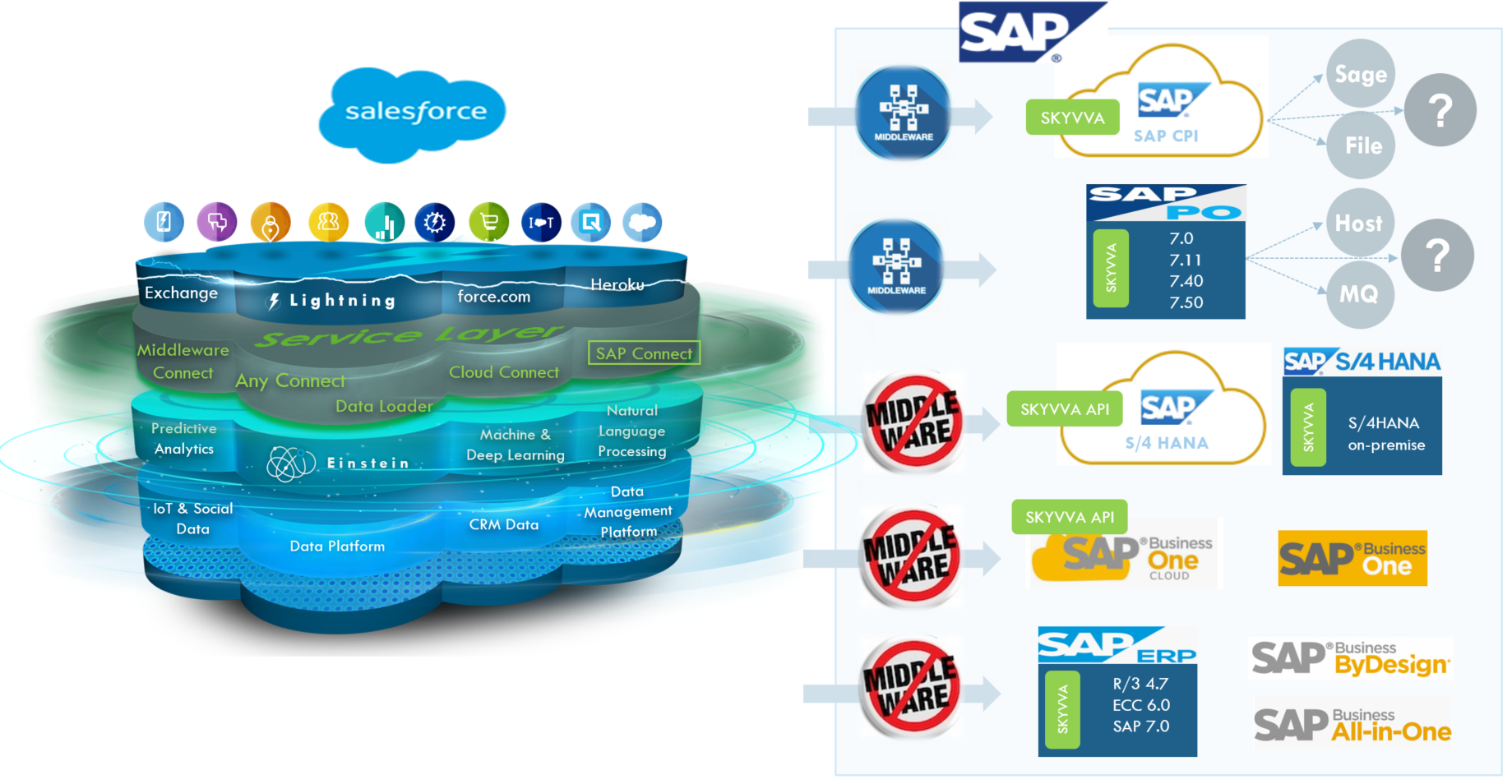
Overview of all available SAP Connect variants in SKYVVA
It makes sense to use specific, best-fit technology and protocol for each solution variant. For example, if you need to connect to SAP ERP ECC 6.0 only and you don't have a middleware, then it makes no sense to buy one first. In this case you can use the SAP ERP Connect variant without a middleware as an integration mediator — the fastest and most optimised way to integrate Salesforce with your SAP ERP ECC 6.0.
SKYVVA has built-in adapters on both platforms to leverage the best available native technology to handle the integration. It supports SAP ERP native protocols such as BAPI/RFC, IDoc, and ABAP-Proxy. You can keep your existing investment and speed up development by reusing existing scenarios where you have used BAPI and IDoc. If you want to use the latest technology such as web services with REST/RESTful approach, the SKYVVA SAP Connect supports that as well.
The picture above gives you an overview of which options and variations you can choose to integrate Salesforce and SAP. SKYVVA offers different ways based on the SAP business suite component used on your end. If you use on-premise middleware such as SAP PI/PO, you can go with the SAP PI/PO Connect. If you are using the cloud version SAP CPI, you can use the SAP CPI Connect. SKYVVA provides native adapters on the SAP side to utilise the most advanced built-in technology available on the platform — creating fast, reliable and optimised integration.
Here are the available SAP Connects:
- SAP CPI Connect
- SAP PI/PO Connect
- SAP S/4HANA Connect
- SAP Business One Connect
- SAP Business ByDesign Connect
- SAP All-in-One Connect
- SAP ERP Connect
On-Premise and Cloud Integration Technology
We have passed the days where we had only on-premise systems to deal with. New, disruptive business requirements definitely demand cloud technology, and thus we have to handle different technology paradigms separately, reflecting their different particularities. Cloud technology is fundamentally different from on-premise because the underlying paradigm has totally changed.
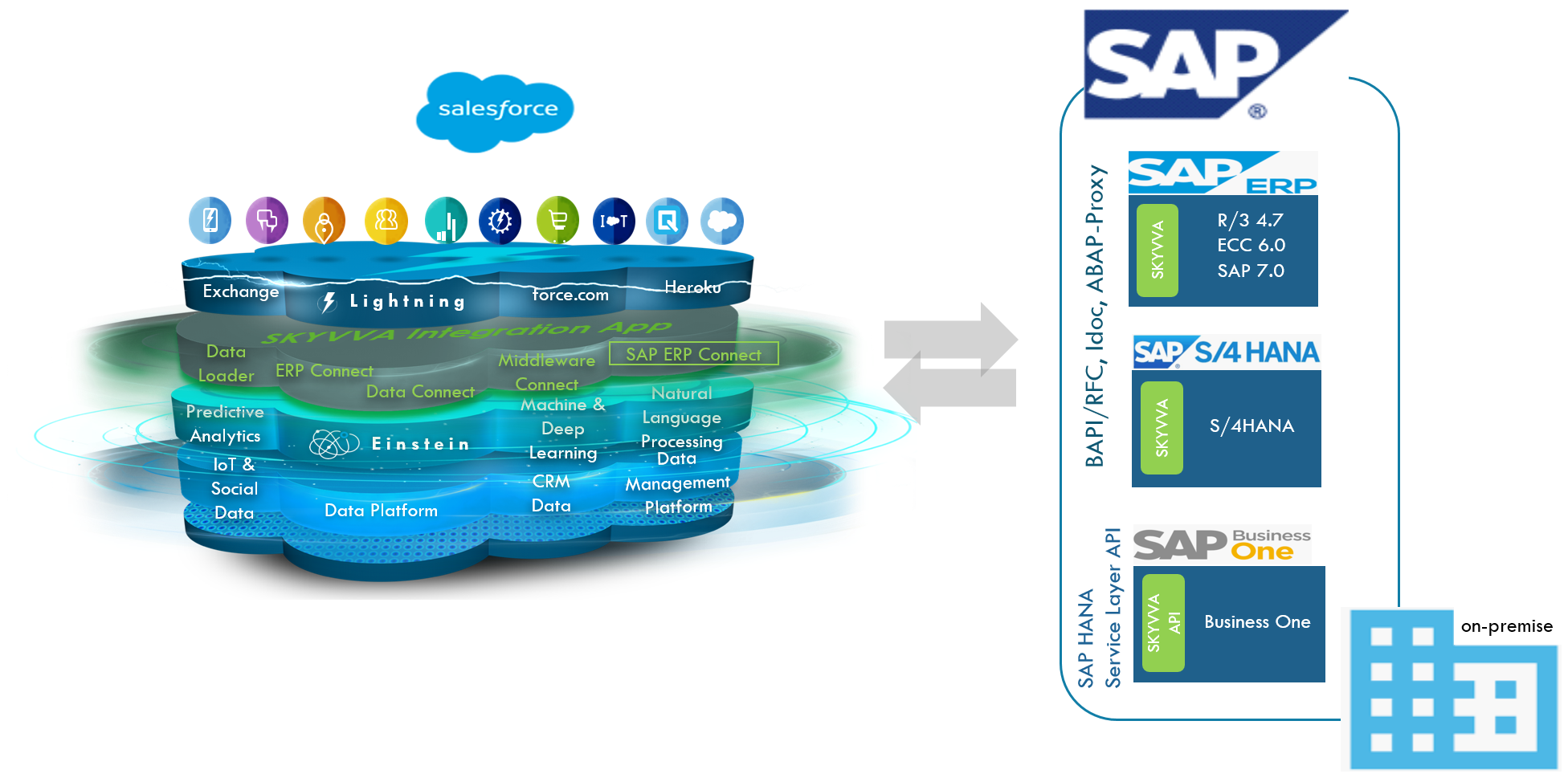
On-premise and cloud integration technology landscape
SAP provides various interface technologies from its first release — starting with RFC, which later evolved into BAPI (following object encapsulation and interface contractual design patterns). For asynchronous communication, IDoc is widely used because it is tightly integrated into SAP modules such as SD, MM, FI, etc. These technologies are based on proprietary RFC, which is based on the CPIC protocol implemented in the C-Kernel of the underlying SAP basis stack. With the emergence of internet technology, the standard HTTP protocol was introduced into the ABAP kernel stack, and new programming models like ABAP-Proxy were created to support open communication using lightweight internet protocols.
This technology is used by the SKYVVA component sitting inside the ABAP stack of SAP ERP 6.0, S/4HANA, and SAP Business All-in-One. For integrating with SAP Business One, the HANA Service Layer is used to connect via the available API. These are the technologies that build a smooth and seamless integration to the on-premise SAP application suite.
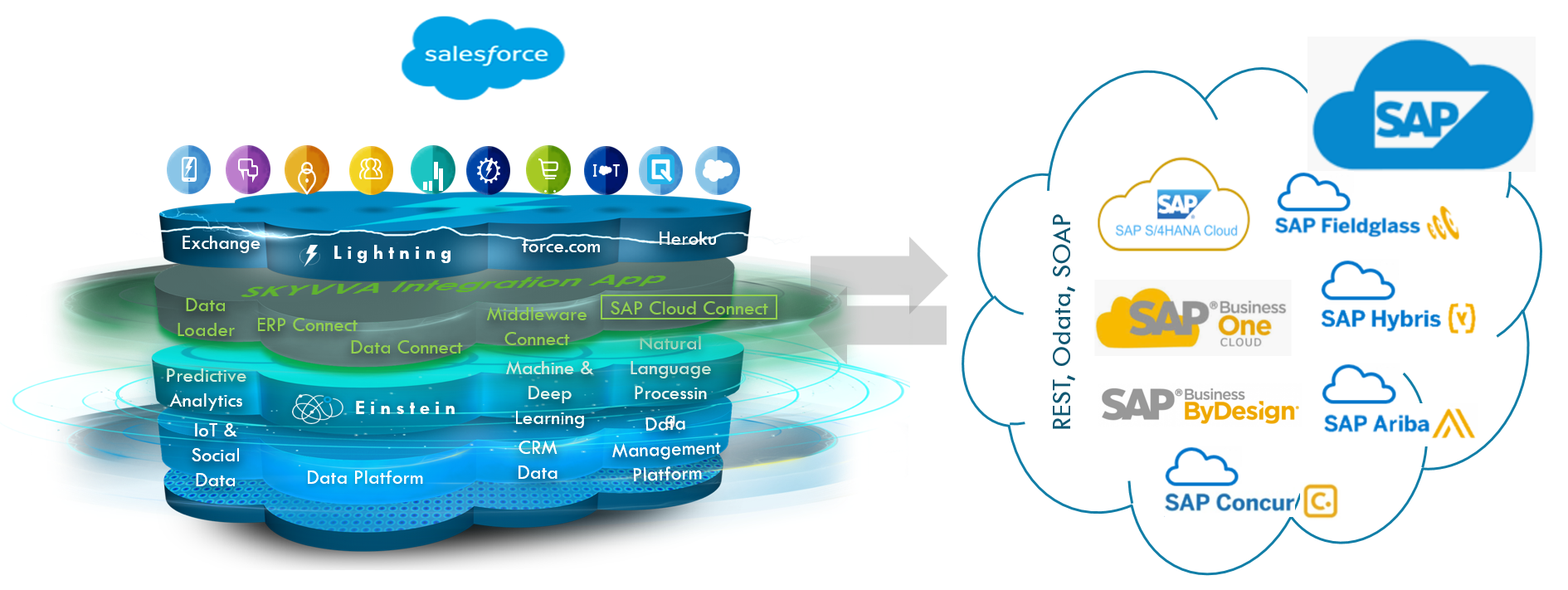
Cloud-based SAP products and their API-based integration technology
On the other side, thinking about the future, SAP has launched different cloud-based products in recent years — such as Ariba, SuccessFactors, Hybris — and released new SAP business suite versions such as S/4HANA Cloud, SAP Business One Cloud, and SAP BusinessByDesign that support cloud deployment.
Common to all cloud applications is that they provide APIs based on SOAP or RESTful technology and design principles. Swagger, OpenAPI 3.x, and OData are emerging standard protocols to define and describe APIs, while for SOAP-based web services, WSDL 1.1 or 2.0 are used. Knowing and building on these technologies is crucial to conform to emerging cloud-to-cloud integration standards. For RESTful web services, OAuth 2.0 is the standard authentication protocol, replacing old-style username/password basic authentication.
Therefore, forcing the same technology on both on-premise and cloud integration scenarios would not make the most use of each technology's strengths. SKYVVA provides dedicated, specific connectors for the on-premise world to leverage SAP proprietary technology, and separate SAP Cloud Connects to leverage standard cloud-based API technology.
Following, we discuss each integration variant in detail.
SAP ERP Business Suite
SAP ECC 6.0 or ERP 6.0 uses the ABAP stack. The interface technology is proprietary and is based on the CPIC library in the SAP kernel. On top of that, the RFC protocol provides the foundation for BAPI/RFC and IDoc. For each SAP module (SD, MM, CO, FI, etc.) there are thousands of BAPIs covering almost any business transaction. Furthermore, customers can create their own RFC functions. While BAPI/RFC is used for synchronous communication, IDoc is used for asynchronous data transfer and is tightly integrated into many SAP modules — for example in ALE and change pointer scenarios.
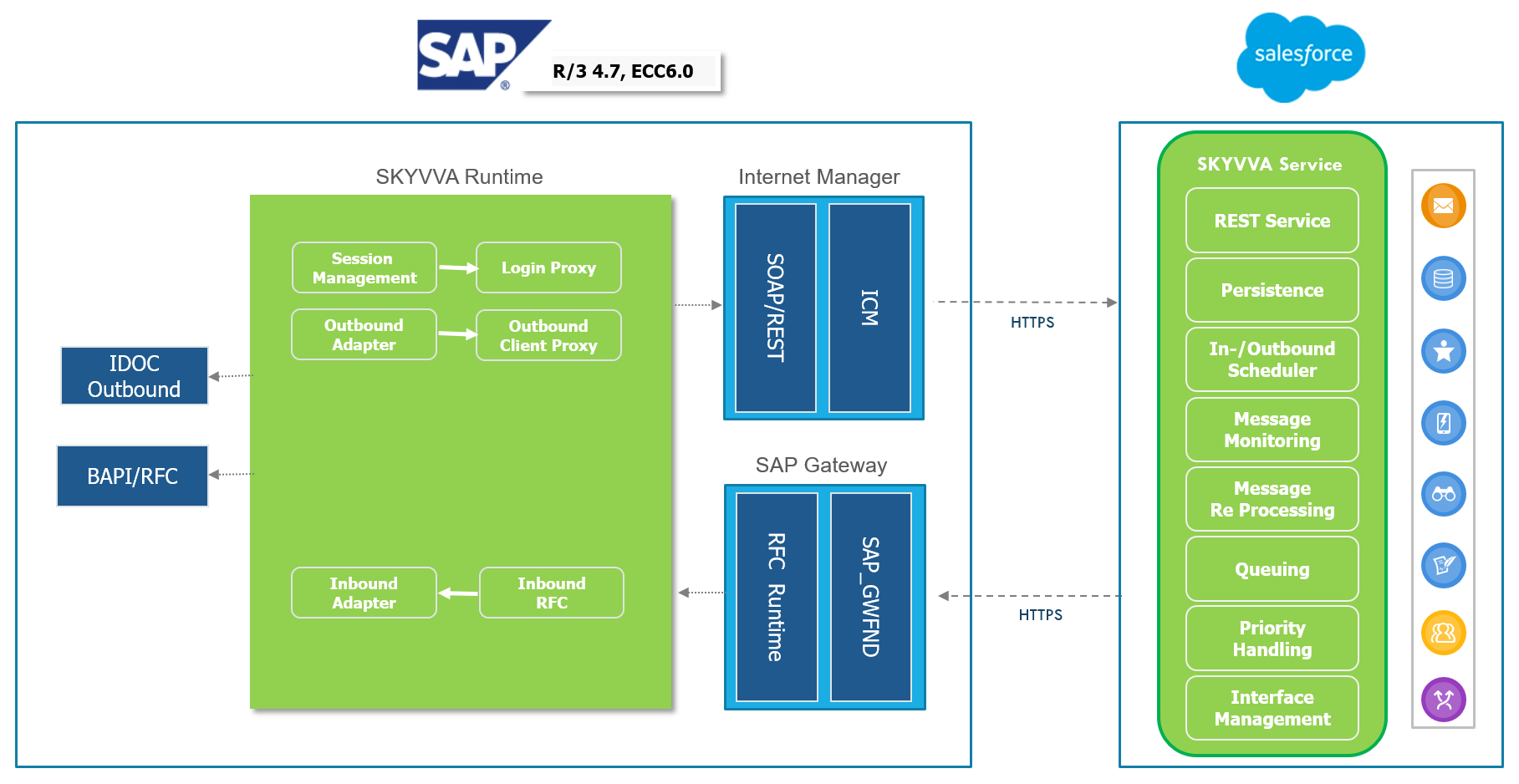
SKYVVA SAP ERP Connect — bridging proprietary SAP protocols to Salesforce
These interface technologies are proprietary and not compatible with Salesforce interface technology, which is based on internet standards using web services over HTTP. Salesforce understands none of the SAP communication protocols, meaning they cannot connect to each other directly. To enable the connection, the proprietary SAP RFC protocol must be converted to the internet standard.
SKYVVA provides a connector inside SAP ECC as a bridge to convert the proprietary SAP protocol to the internet standard, so that the Salesforce SOAP and REST API can be used. It leverages the built-in ICM (Internet Communication Manager) component from SAP to implement internet protocols and uses the standard SOAP and REST technology provided by the SAP Gateway. Additionally, SKYVVA adds a service layer on the Salesforce platform to provide enterprise-class capabilities — message monitoring, reprocessing, alerting, and error handling — that are not available with the standard API alone.
S/4HANA On-Premise
Since its launch in February 2015, S/4HANA has become a significant path for customers still using SAP ERP 6.0 and planning to move to the new technology built on the HANA database. The application layer is still based on the core ABAP stack but has been enhanced to support the latest technology in terms of performance and cloud readiness. From a functional perspective, it offers simpler and lighter modules for some business areas, and unlike SAP ERP Business Suite, it does not follow a monolithic approach.
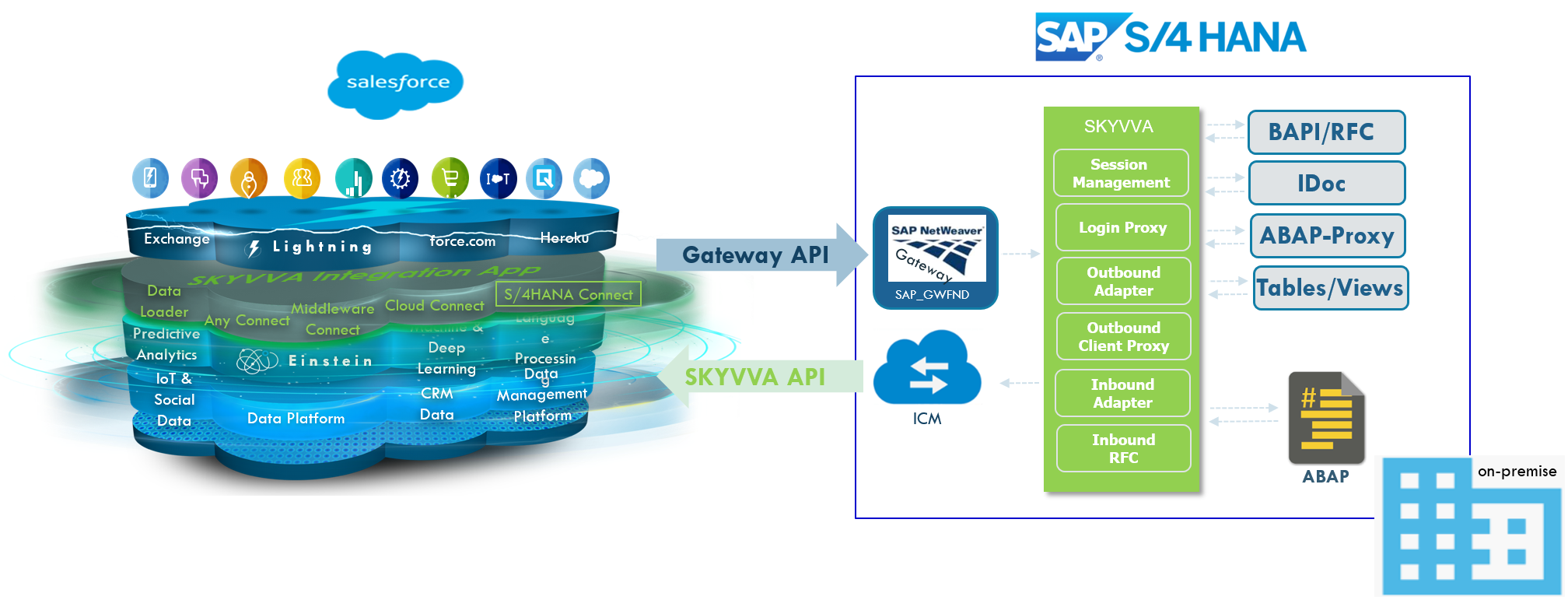
SKYVVA S/4HANA On-Premise Connect — native ABAP component for Salesforce integration
S/4HANA on-premise keeps the same technology stack as the SAP ERP Business Suite, so the integration and interface technology remains the same but with some improvements. SKYVVA has adapted the SAP ERP Connect to support native elements and enhancements of S/4HANA, providing a native component for Salesforce integration.
S/4HANA Cloud
S/4HANA is not only changing the underlying database to use the in-memory approach — from a deployment perspective, it has also followed the cloud computing paradigm by offering a cloud option. This is the biggest update in SAP's ERP strategy and enables customers to move into cloud computing or remain on-premise.
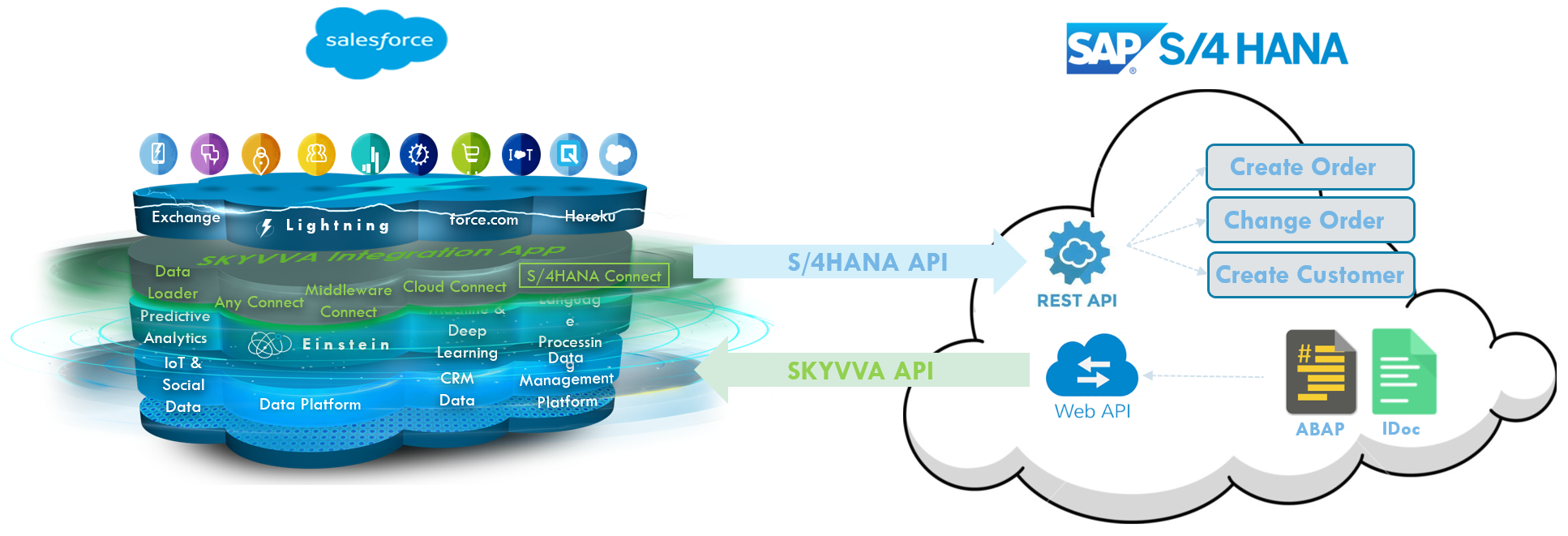
SKYVVA S/4HANA Cloud Connect — REST/OData-based cloud-to-cloud integration
Regarding the technology stack, SAP S/4HANA covers different types of APIs — web service-based APIs (OData, REST, and SOAP), traditional SAP APIs (BAPIs and IDocs), and CDS views that can be exposed as OData services. The SKYVVA S/4HANA Connect uses web API technology based on RESTful architecture. From the S/4HANA perspective, SKYVVA provides REST APIs to integrate seamlessly with the SKYVVA service layer.
SAP Business All-in-One
SAP Business All-in-One is a special offering that is no longer actively promoted by SAP. It falls into the Small and Medium Enterprises (SME) product area and was intended to deliver a pre-packaged, industry-specific bundle of SAP ERP. It is based on the SAP NetWeaver stack and therefore leverages the same ABAP platform as SAP ERP 6.0. The integration technology SKYVVA provides here is similar to the SAP ERP 6.0 edition — please refer to the SAP ERP Business Suite section above.
SAP Business ByDesign
SAP Business ByDesign is a cloud offering now under the category of SAP Cloud ERP. It was developed by SAP for small and medium-sized businesses and is based on SAP's "best practices".
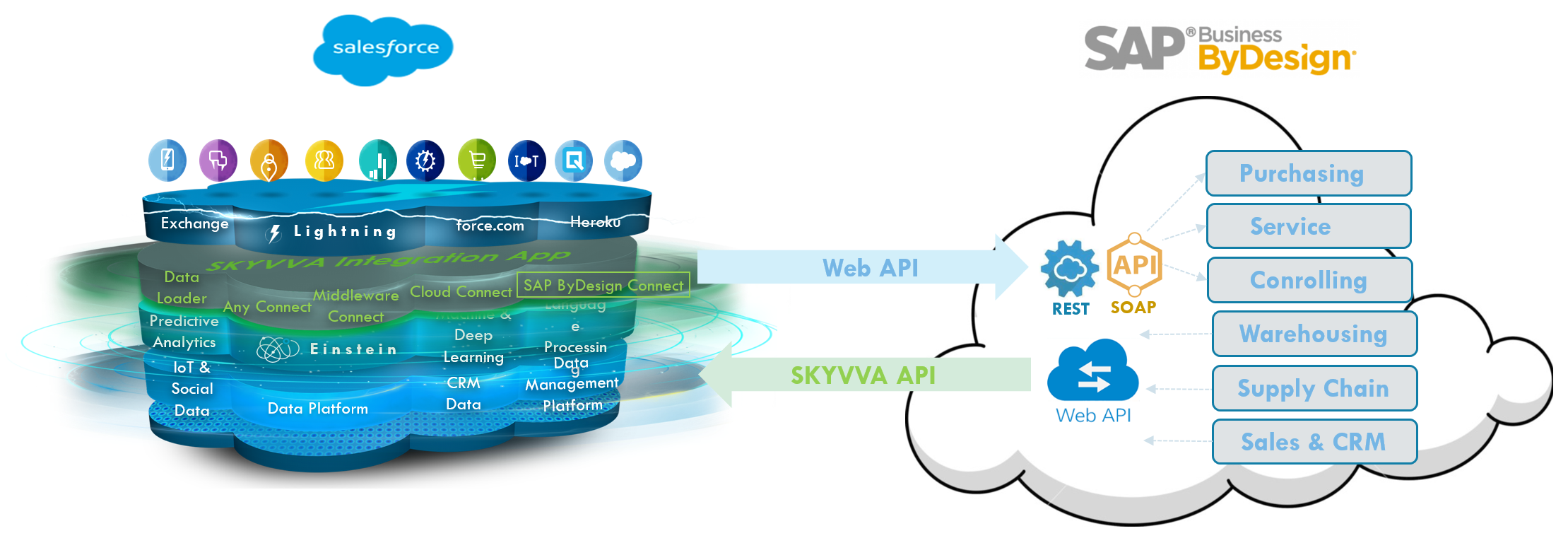
SKYVVA ByDesign Connect — OData API-based integration for SAP Business ByDesign
For integration with external systems, SAP Business ByDesign provides a set of APIs including OData endpoints to seamlessly execute business operations on given objects. For example, the Sales Order API allows creating and changing sales orders and their document flow. The SKYVVA ByDesign Connect uses web API technology to integrate Salesforce with SAP Business ByDesign.
SAP Business One On-Premise
For data exchange, SAP Business One provides two Application Programming Interfaces (APIs):
- SAP HANA Service Layer API Technology — The next-generation API for digital business, allowing you to create lightweight mobile apps consuming SAP Business One data and services using open-core protocols such as HTTP and OData. This technology is only available for SAP Business One, version for SAP HANA.
- SAP Business One DI API — The DI API contains objects and methods that enable developers to read, write, update, and remove data objects at the database level. This DI API is also available for SAP Business One on MS SQL.
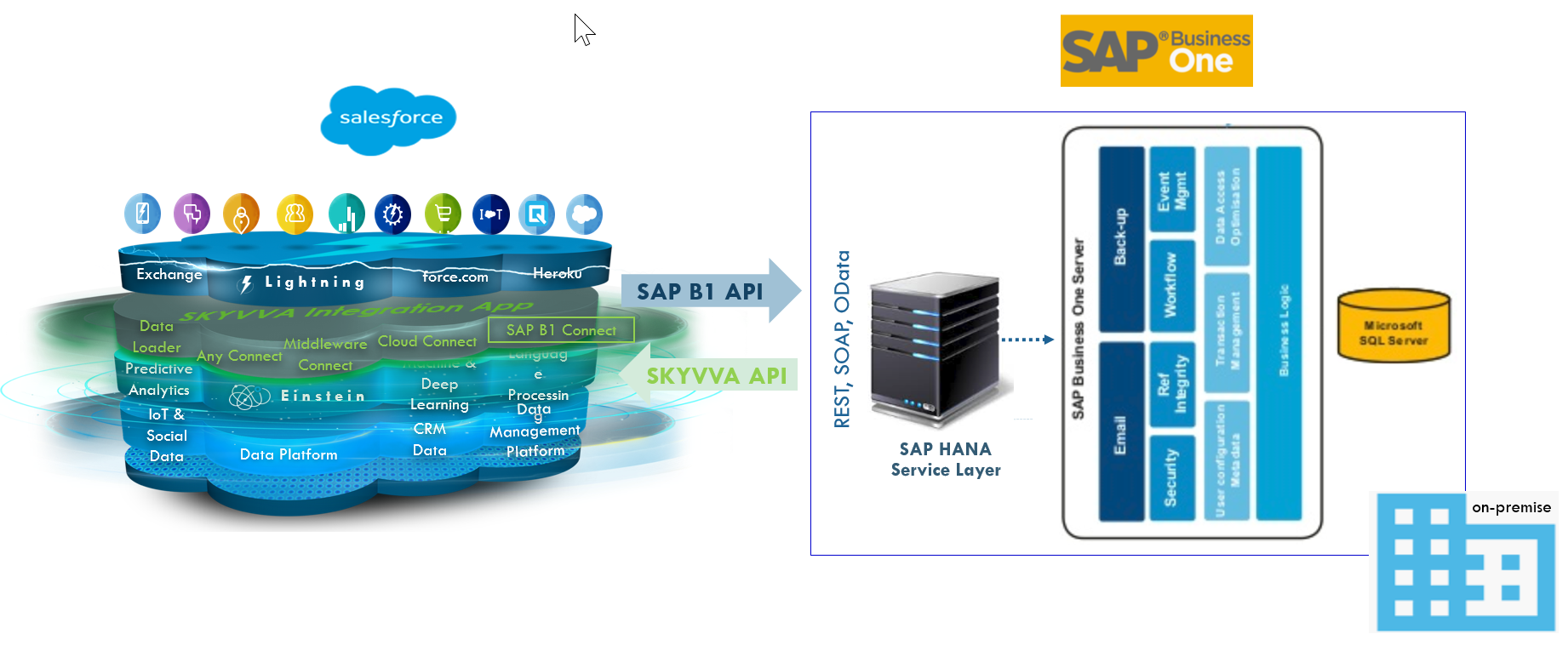
SKYVVA Business One Connect — Service Layer API-based integration
SKYVVA supports the latest technology using the Service Layer to connect from Salesforce through the API to the Business One Server. All available APIs from SAP Business One can be used to create, read, update, and delete application objects. Business application functions can also be executed through the SOAP interfaces.
SAP Business One Cloud
SAP Business One can run on cloud, which simplifies the hardware and software landscape within your company. There are two cloud deployment options: you can either get your own license and have your SAP partner host the service for you, or you can rent on a monthly basis from SAP. Regardless of which deployment option you choose, the underlying basis is the same — which means the integration technology is the same.
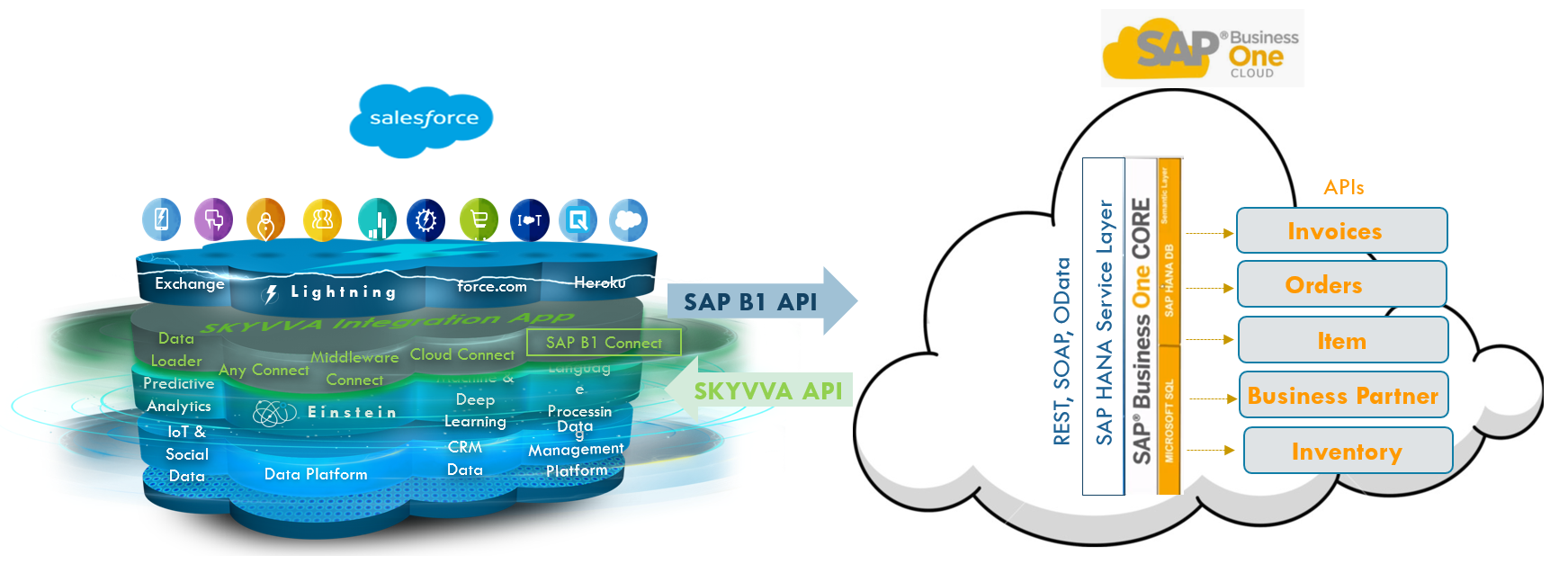
SKYVVA Business One Cloud Connect — cloud-to-cloud integration approach
On the cloud layer, the same components and technology are used for integration as in the on-premise deployment. The SAP HANA Service Layer can be used to provide REST, SOAP, and OData services to access business functionality via APIs. SKYVVA Business One Connect can be used to integrate with SAP Business One as a cloud-to-cloud approach.
SAP PI/PO (Process Integration / Process Orchestration)
SAP PI/PO is a middleware that handles all kinds of integration, mostly used to integrate your SAP software landscape and other on-premise applications. It provides various adapters to connect to business systems and gives you the power to design, develop, and run integration scenarios within your on-premise landscape.
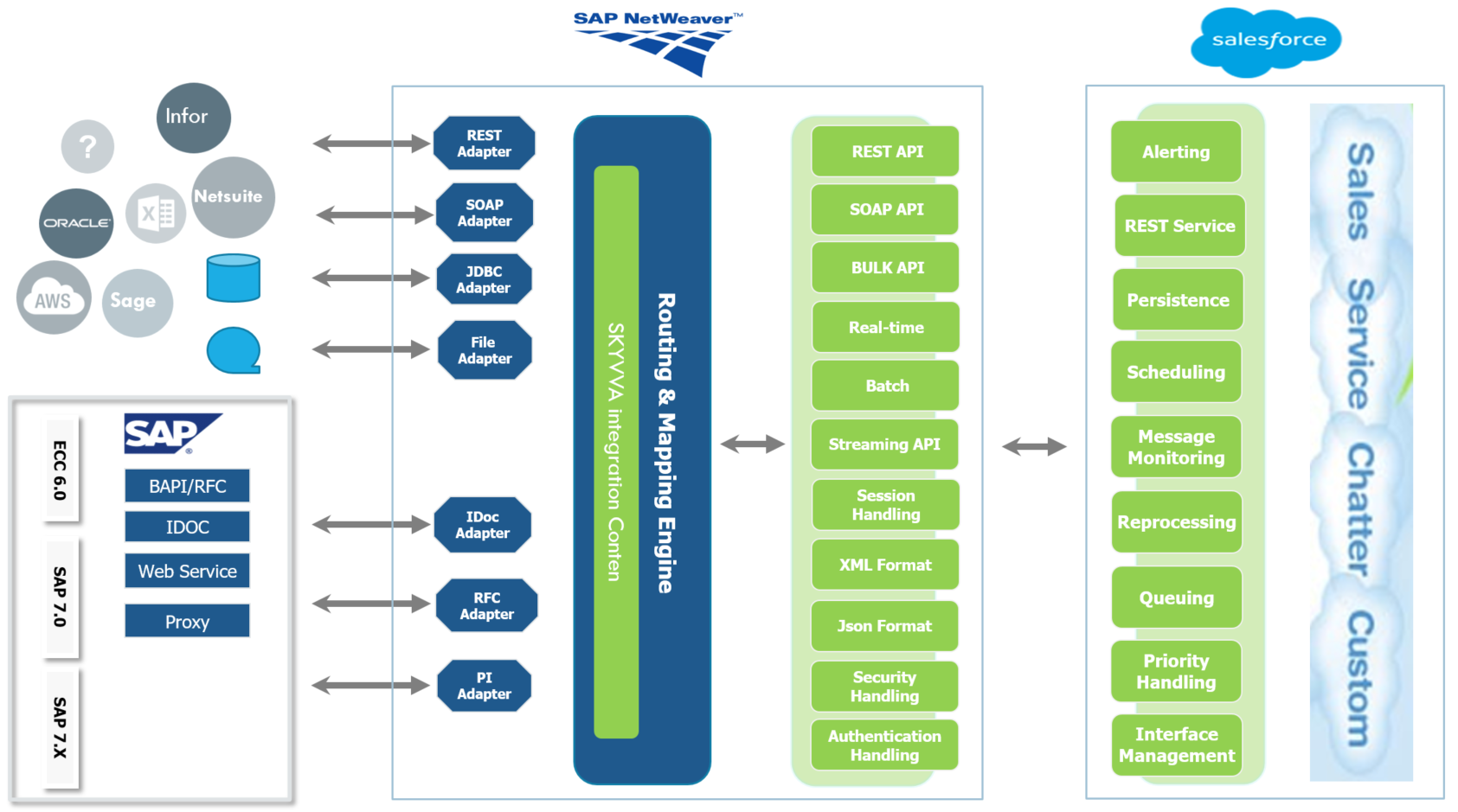
SKYVVA PI/PO Connect — native J2EE connector for SAP Process Integration / Process Orchestration
The integration to and from SAP PI/PO is done using the SKYVVA connector component sitting directly on the J2EE Engine of the SAP PI/PO engine. This component handles all connection requirements to and from Salesforce and offers specific Salesforce features available as an additional layer on the Salesforce side — including:
- Message monitoring
- Message reprocessing
- Alerting
- Error handling
These features give you operational tools to handle your daily integration challenges. From a technology standpoint, the native components talk directly to each other to achieve the best possible integration speed — no intermediary impacting the integration flow through protocol or format conversion. SKYVVA components use native techniques and programming libraries on each side.
For common integration use cases such as Account, Contact, Quote, etc., SKYVVA provides ready-to-run integration apps on SAP PI/PO that can easily be deployed and adapted to business requirements quickly — reducing your development cycle and saving cost and effort considerably.
SAP CPI (Cloud Platform Integration)
SAP CPI is the cloud integration tool offering from SAP, following the cloud computing paradigm with the latest cloud technology for their integration solution suite. Similar to SAP PI/PO, it provides almost the same functionality and adapters and is compatible in terms of — for example — the mapping engine. SAP PI/PO mappings can be reused in the CPI runtime.
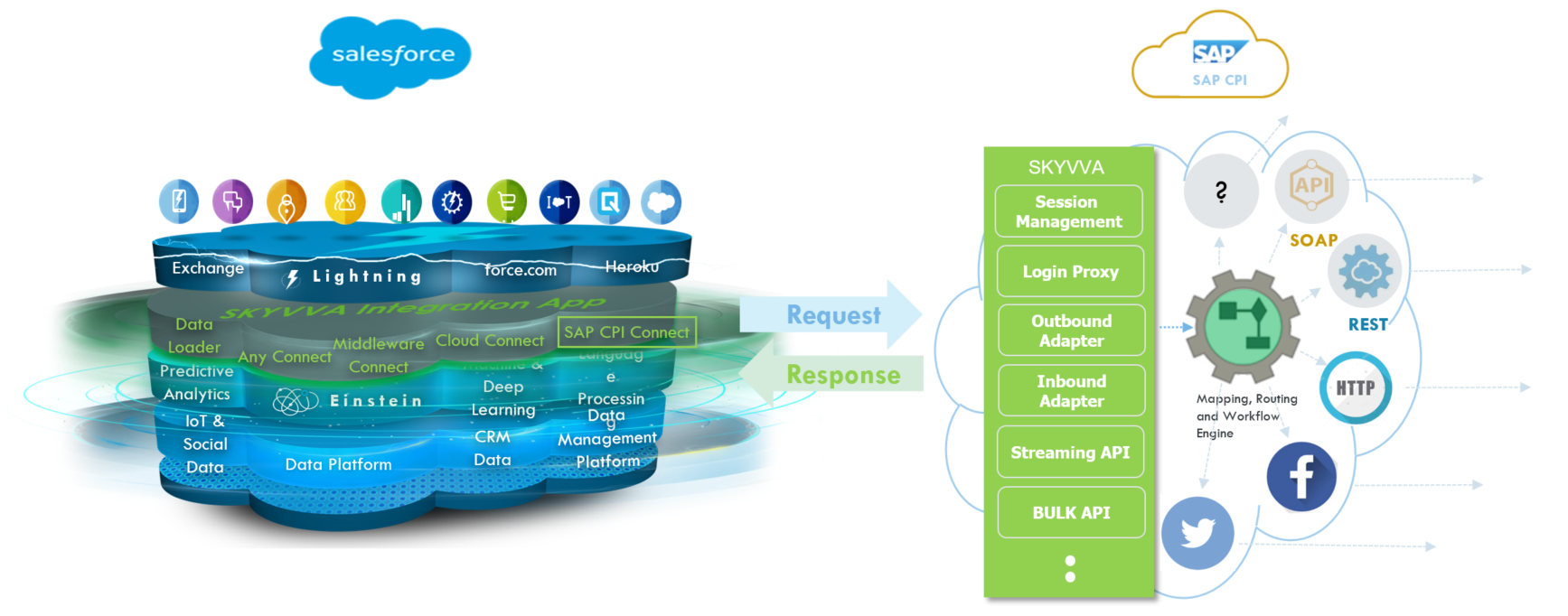
SKYVVA CPI Connect — native adapter built with SAP Adapter SDK for Cloud Platform Integration
SKYVVA provides a native connector developed with the Adapter SDK from SAP, leveraging as much of the available technology as possible. It provides inbound and outbound adapters to handle both communication directions, supporting streaming and Bulk API to handle special requirements for Salesforce integration.
The adapter can be deployed to your CPI tenant as a third-party adapter, and there are also pre-defined integration apps available — similar to the SAP PI/PO edition.
SAP Cloud Platform Open Connectors
With its latest cloud offering, SAP announced Open Connectors, which provide 100+ connectors for different use cases. One of the available connectors is the Salesforce connector, which uses the Salesforce standard API to provide integration services. However, the issue with any standard Salesforce adapter is the limitation that comes with the pure API connectivity approach — for some integration requirements, it is too basic and low-level, providing only CRUD operations.
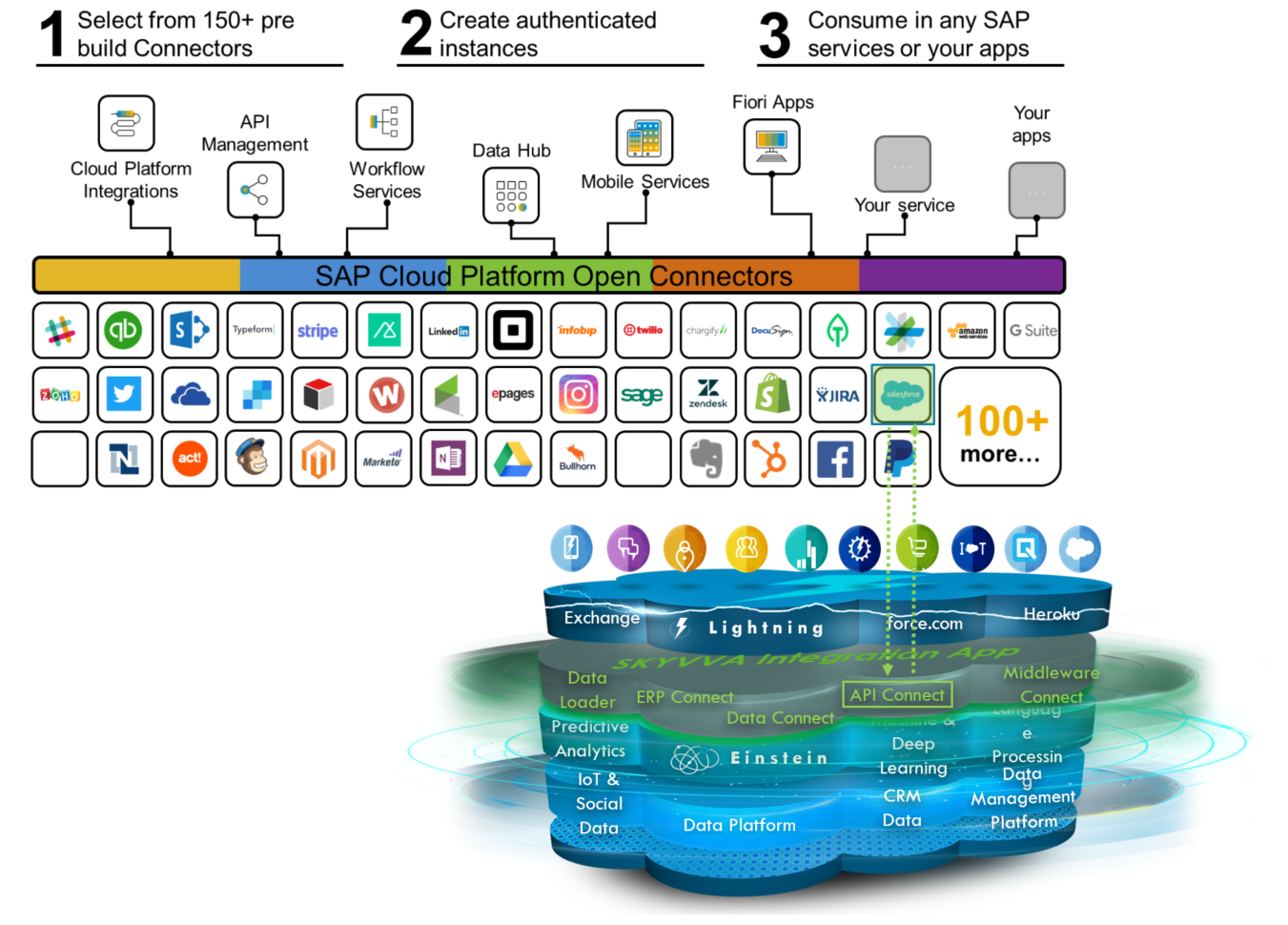
SKYVVA API Connect — adding enterprise-grade service layer on top of SAP Open Connectors
Therefore, SKYVVA has added the so-called API Connect to provide SKYVVA value-added APIs to external systems, enabling them to connect to the SKYVVA service layer and gain all the value-added features and capabilities missing from the standard Salesforce connector. With the additional service layer on the Salesforce side, you will add more quality and save significant cost in your daily interface operations.
Summary
You have now seen the possible solution landscape used within the SAP environment — the most common configurations you will encounter. The integration is based on SAP's common technology but has its own specifics, and thus SKYVVA provides for each option a dedicated connector to handle the technology, protocol, and data format in an optimised way. The connector is developed in SAP native technology to be able to use all available tools, techniques, and protocols.
Unlike other solutions on the market, the direct and native approach doesn't create any friction between connected systems. It is the fastest and most optimised way you can think of for an SAP and Salesforce integration. If you need performance, reliability, directness, a lightweight and cost-effective solution without having to buy another middleware — this is the option to go.
What is your SAP integration need? To which system do you want to connect? Is there something missing? This blog covers the most common SAP systems used at companies of all sizes. Nowadays, with the cloud option, there is a seamless way to connect Salesforce to SAP Cloud directly as a cloud-to-cloud connection without any middleware in between. There is simply no need for an intermediary — middleware only causes unnecessary complexity. Go the new and direct cloud-to-cloud connect approach to disrupt your business and stay ahead of your competitors for Salesforce-centric, solution-based processes.
Ready for a native Salesforce–SAP integration?
Discover how SKYVVA connects your SAP landscape with Salesforce — no middleware, no compromises.
Request Demo →