Salesforce — with its applications for sales, service, marketing, e-commerce, community, and the wide variety of apps built by third-party vendors — has evolved into a platform economy and become the de-facto standard for CRM business in the cloud. On the other side, legacy applications are being modernised with new technology, new applications are being built using the cloud paradigm, and existing ERP systems like SAP are becoming the digital enterprise backbone. Customer engagement, customer success, and the 360-degree view around customers are the key success factors in today's business — making Salesforce the digital front-end core.
When it comes to integration, middleware is often the first solution that comes to mind. At first glance it sounds reasonable — middleware integrates everything with anything by its very nature. But do you really need such a full-blown, heavy, generic, multi-purpose hub when your requirement is simply to integrate Salesforce as your digital front tier with other systems and applications?
What Middleware Can Do
Let's look at and understand the nature of middleware. The key function of middleware is to interconnect different applications that speak different languages and are based on different technology. Because they are built using different programming languages, operating systems, databases, and technical protocols, they are incompatible, non-interchangeable, non-interoperable, and heterogeneous. The approach of middleware is to build a central hub for application interconnection through message exchange. It provides data transformation, mapping, protocol conversion, interface and receiver determination, connection routing, and much more to handle all routing and connectivity tasks.
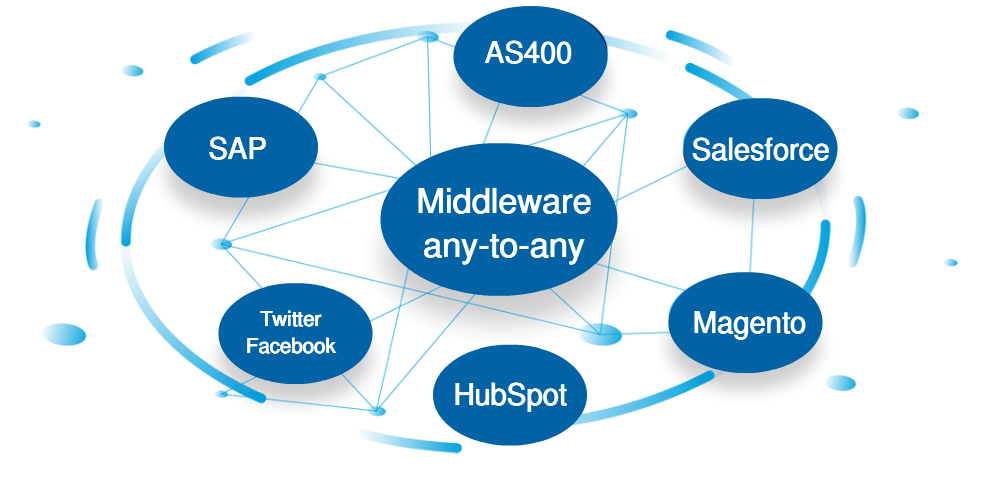
Middleware as a central integration hub — connecting heterogeneous systems
Middleware's approach is to serve any integration requirement where Salesforce is just one of multiple connected endpoints. It cannot and will not leverage the specific particularities and special features of the Salesforce platform — for example the Salesforce governor limits — because it is not designed to handle only the Salesforce endpoint. The only available feature is technical connectivity using the standard Salesforce API. Why going beyond the simple API-connected approach is essential for enterprise-class integration is a topic in itself.
Think Salesforce-Centric
Since Salesforce is your platform of customer success, it must be the highest focus when it comes to integration with other applications and systems — like your ERP backend core. The perspective must shift to make Salesforce the digital core by moving holistic processes to the Salesforce platform, enabling you to handle integration alongside business processes in one place.
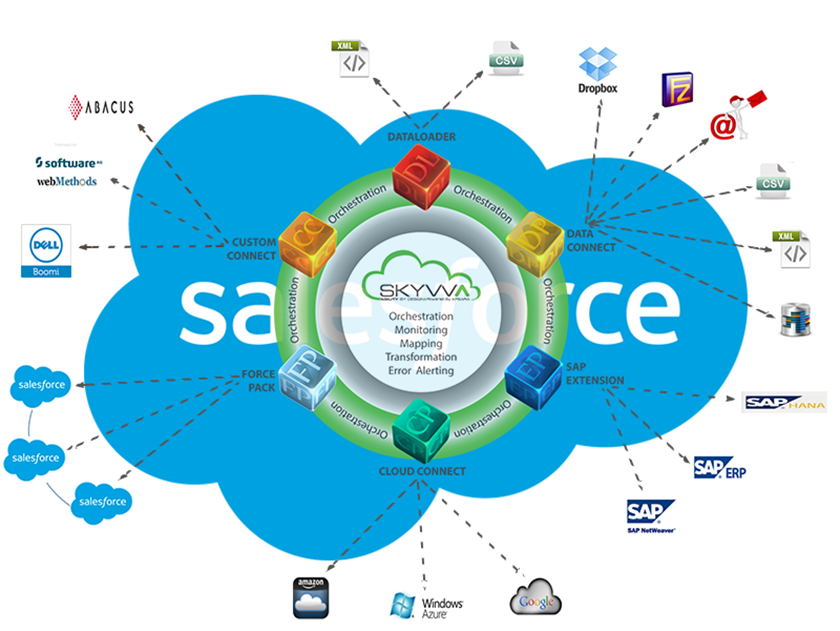
Moving integration to the Salesforce platform for a unified, frictionless architecture
Running both processes — business and integration — on the same platform is fast, highly performant, effective, and — due to native technology — frictionless. Only native technology can provide such excellent performance and awareness of all Salesforce specifics. SKYVVA revolutionises this approach by moving integration to co-exist with business processes, reducing complexity and minimising the cost of maintaining a separate, full-blown middleware just for Salesforce integration with other application systems.
Leverage Your Salesforce Investment
Alongside other business applications like SAP (ERP), Oracle (database), and data on legacy storage, your Salesforce platform already exists and the investment has been made. As your Salesforce business grows and processes begin to span multiple applications across your software landscape, integration becomes necessary. There are different options — developing the integration yourself or using a middleware — but both are expensive: you must first invest in a middleware (either on-premise or cloud), build teams to maintain it, and train staff to operate it. Why not leverage the existing Salesforce platform where you already have a team, skills, and knowledge?
With SKYVVA you have all the possibilities to integrate any application to and from Salesforce — without a middleware — keeping your investment and building a homogeneous software landscape. This is the key factor in reducing daily operational costs, keeping things simple, and freeing up your resources to start new projects: bringing artificial intelligence, Big Data, Process Automation, and more into your enterprise.
Middleware: A Heavy Champion
Middleware is designed to handle all types of application and system integration in a generic way. Due to its open nature and the wide range of protocols, applications, and connectors it must support, middleware becomes a large and monolithic hub. Maintaining such a system requires skilled and well-trained staff, and due to its complexity even in-house teams often cannot handle it fully — making expensive external consultants necessary.
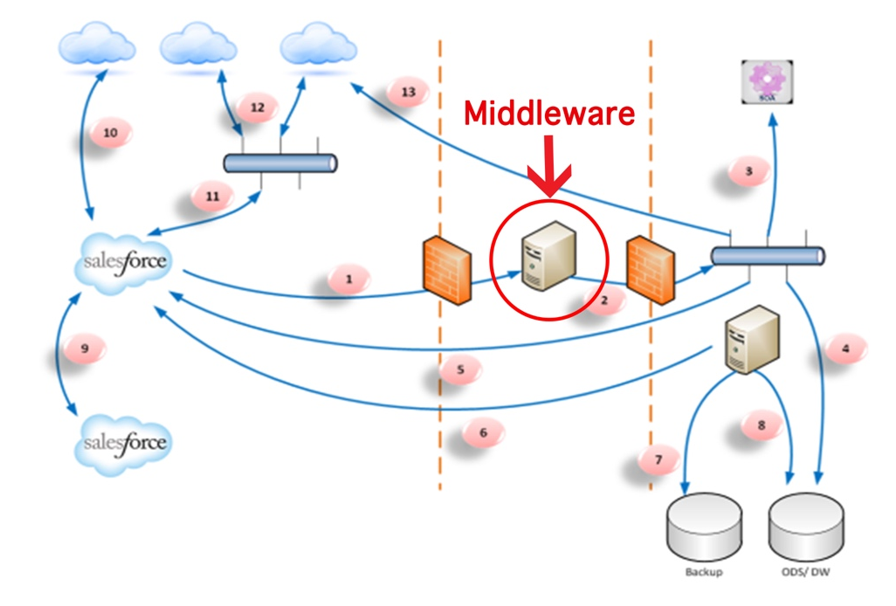
The infrastructure overhead of operating a middleware in a high-availability environment
Not only the functional complexity — data transformation, mapping, routing, process engine, and protocol conversion to and from different technical adapters — makes middleware heavy. The infrastructure required to operate a middleware in a multi-server, high-availability environment is also a major challenge: firewalls must be configured, network zones defined, security and encryption installed, and SSL certificates maintained across multiple servers. Maintaining and operating a middleware is one of the biggest tasks in any IT department and ties up valuable resources.
Designed to Be Lightweight
What are your requirements for Salesforce integration? When you consider this question, your desire is to make Salesforce processes smooth and frictionless. You want to handle your Salesforce integration to and from any application, focusing on Salesforce as the only integration endpoint. A multi-purpose, multi-endpoint approach like middleware offers is not needed in this use case. With this requirement in mind, SKYVVA has been designed as a native Salesforce app that provides all integration services on the Salesforce platform. It takes full advantage of all Salesforce technologies through its native Apex code and leverages all out-of-the-box features like Process Builder and Flow to design business processes. Even artificial intelligence services like "Einstein" can be leveraged by SKYVVA.
The nature of the Salesforce platform allows third-party vendors to create smart, lightweight apps serving a specific business domain. Focused and Salesforce-centric, the app is easy to use and manage, and can be adopted by your existing Salesforce staff in days instead of the months or years that a full-blown middleware requires. No training on a separate platform is needed because it is a Salesforce Lightning App with the same look and feel as any other Salesforce application.
Lightweight or Heavyweight?
That is a very good question. Both approaches serve their specific integration use cases and requirements, and each has its own strengths, weaknesses, advantages, and disadvantages. Ultimately, you must evaluate different aspects: which approach is most cost-effective, which offers operational agility, ease of maintenance, and fits the team and skills you currently have or would need to hire.
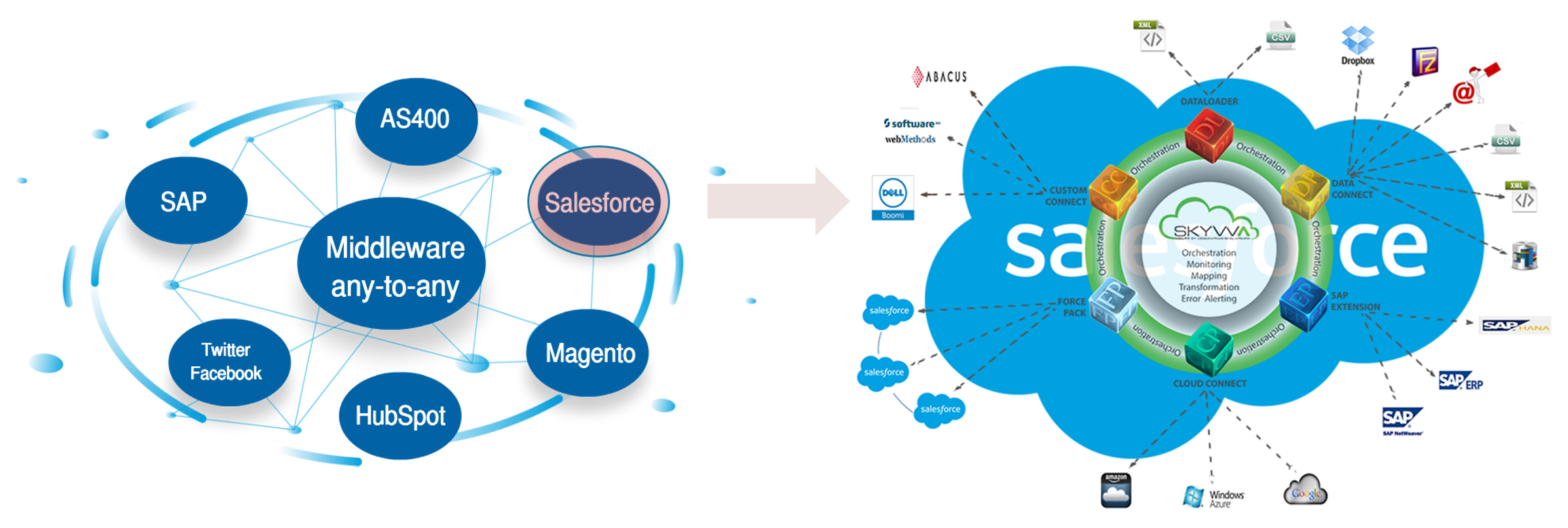
Comparing lightweight Salesforce-native integration with traditional heavyweight middleware
When your plan is only to integrate Salesforce as your digital front tier with other applications, a lightweight approach is smart enough and fulfils all your business demands. The lightweight approach is the foundation for business agility in today's digital world — enabling smart, specific apps to adapt rapidly. Middleware is somewhat an enterprise-based approach from an earlier era, where monolithic applications had to interconnect and messages with different protocols had to be converted. With Salesforce as your digital core for customer success, you need a more agile, flexible, and smart integration app that can be adopted very quickly to serve your demanding and rapidly changing business requirements.
Why the Salesforce Platform?
This question is not about whether to use Salesforce as your digital core for the customer success platform — you have already chosen it for good reasons, and with confidence that it will fulfil all your requirements for the next decade. This question is about why you should use the Salesforce platform for integration services instead of a separate middleware.
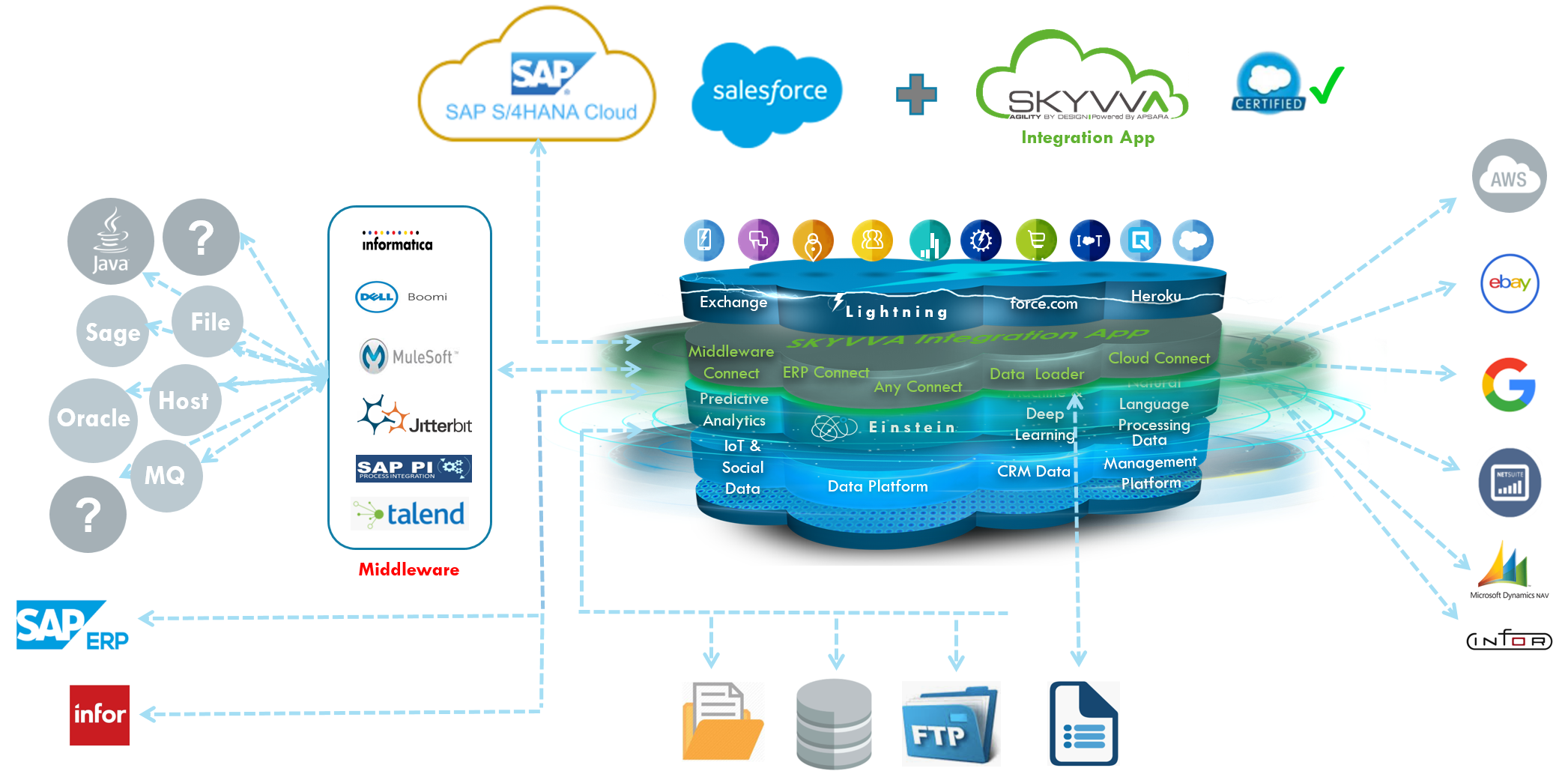
The Salesforce platform provides the ideal foundation for native, Salesforce-centric integration
The layered architecture of the Salesforce platform provides multiple built-in services out of the box — security, encryption, job scheduling, workflow, Process Builder, Flow, and the powerful programming language "Apex" to handle all kinds of business requirements. The platform allows customers and third-party vendors to implement new apps and build together the Salesforce ecosystem.
SKYVVA has chosen the Salesforce platform for its integration services to protect customer investment without forcing them to use a separate middleware. Even if a middleware is used, SKYVVA can enhance pure connectivity with value-added services — such as monitoring, alerting, message reprocessing, and error handling — inside the Salesforce platform, making integration transparent and traceable end-to-end.
Consider high-availability: your customer-centric processes run inside Salesforce and span other applications and services outside the platform. Having integration services inside the platform makes them independent of middleware failures. Middleware is complex by nature and difficult to operate — it can fail during operating hours. If the middleware breaks, your Salesforce integration breaks too, even though Salesforce itself is still running. You can still execute Salesforce processes, but without working integration to your ERP or other connected services. This is a nightmare and causes real business damage.
In contrast to middleware, the availability of the Salesforce platform is around 99.99%. The global Salesforce data centres handle all failover and disaster-recovery strategies. Transparency is provided at all times at trust.salesforce.com. Since SKYVVA resides on the platform, it is as highly available and secure as Salesforce itself.
Another reason to choose Salesforce as the platform for integration services is the ability to seamlessly embed integration with the business services residing on the same platform. The following are some examples of the architectural benefits:
- SKYVVA message objects can be linked directly to Salesforce application objects like Account or Contact for better traceability — you can navigate directly between a SKYVVA message and the corresponding Salesforce application object.
- Message data can be mixed and merged with Salesforce business data without having to traverse the internet to retrieve it — unlike middleware, which must orchestrate additional API calls and risks exhausting the 24-hour API limit.
- Smart governor limit checks can be built and handled natively inside the platform, respecting Salesforce multi-tenancy constraints such as CPU time, heap size, concurrent transactions, and API calls.
- Built-in tools like Process Builder and Flow, plus programmatic capabilities like Apex classes and triggers, can be used to add business logic alongside integration logic — all in one place.
- Salesforce social and community features can be used for error handling and alerting — for example, a Chatter group can be used so that followers receive alerts when a message fails to be processed.
There is much more built-in functionality in the Salesforce platform that a native Salesforce app can leverage for its purpose.
The most cost-effective reason is the skills, knowledge, and Salesforce team you already have in-house. There is no need to train staff on a new platform or build a separate middleware team. The SKYVVA app is a Lightning App with the same look and feel as any other Salesforce application — your Salesforce staff is already familiar with it. When you go with middleware, you have to build a new team of at least two staff members (for redundancy when someone is sick or on holiday). All of this produces not just a one-time cost but ongoing monthly and yearly costs for your company.
Summary
Salesforce integration is crucial today — it is your customer success platform and the digital front-tier core. In addition to Salesforce's own built-in applications, third-party applications provide different kinds of services and are evolving the platform into a rich, scalable ecosystem. Many vendors delivering solutions on the platform have proven the scalability, robustness, security, and stability to host and run any kind of service. SKYVVA has adopted the platform and provides the best Salesforce-centric integration service to bring any application, platform, and system together in one place with one technology.
This approach eliminates the need for heavyweight middleware for Salesforce integration, since middleware cannot handle the specific characteristics of the Salesforce platform sufficiently. Furthermore, it is not the purpose of a middleware to focus exclusively on one platform to provide the best and highest-performing solution — it focuses on all connectors and integration capabilities in a generic way and therefore cannot be effectively tailored for Salesforce integration. In contrast, SKYVVA was purpose-built and optimised for highly efficient Salesforce integration, connecting Salesforce to any application and any application to Salesforce — covering all integration scenarios and use cases.
Ready for a native Salesforce integration?
Discover how SKYVVA connects your system landscape with Salesforce — no middleware, no compromises.
Request Demo →